
 English
 русский
 简体中文



Home / News / Industry News / Aluminium Screw Caps for Pharma Bottles: Neck Finish, Liner and Torque Guide
Aluminium Screw Caps for Pharma Bottles: Neck Finish, Liner and Torque Guide
2026.10.29
Content
- 1 What a Screw Cap Aluminium Closure Contains
- 2 How Screw Caps Compare with Other Aluminium Closures
- 3 Neck Finish and Thread Tolerance Decide the Fit
- 4 Liner Choice Protects More Than the Shell Does
- 5 Torque, Line Setup and the Numbers Behind Leakage
- 6 Quality Checks and Documentation Buyers Should Request
- 7 Specifying a Screw Cap Aluminium Order
A syrup line running at 200 bottles per minute rarely stops because the aluminium shell failed. It stops because the liner was 0.3 mm thinner than specified, the capping head was set two in-lb too tight, and the bottle neck came from a mould nobody matched against the cap drawing. Screw cap aluminium looks simple from the outside. Inside a pharmaceutical filling hall it is a four variable problem.
Those four variables are neck finish, shell dimensions, liner and application torque. Fix them together and a screw cap seals, reseals and passes leak testing for years. Treat them separately and the same cap leaks on one glass supplier and grips too hard on another. The sections below explain what each variable does, where the tolerances sit, and what to write into a specification before tooling starts.
What a Screw Cap Aluminium Closure Contains
An aluminium screw cap is a one piece drawn shell with a rolled thread and a liner disc. The shell begins as aluminium strip, usually alloy 8011, 3105 or 3003, at 0.15 mm to 0.25 mm thickness. A press draws the cup, forms the thread, adds knurling for grip and trims the skirt. A tamper evident band can be bridged to the skirt and separated on first opening.
The liner is the functional part. Without it, aluminium against glass is metal against an uneven surface, and sealing depends on how hard someone turns the bottle. With it, the liner deforms into the glass land and creates a measurable seal.
Screw caps appear on oral liquid bottles, syrups and suspensions, vitamin and drop bottles, and some diagnostic reagent packs. Common neck finishes in this group are 18 mm, 20 mm, 22 mm, 24 mm and 28 mm. A pharmaceutical screw cap differs from a cosmetic closure in documentation and cleanliness, not in geometry.
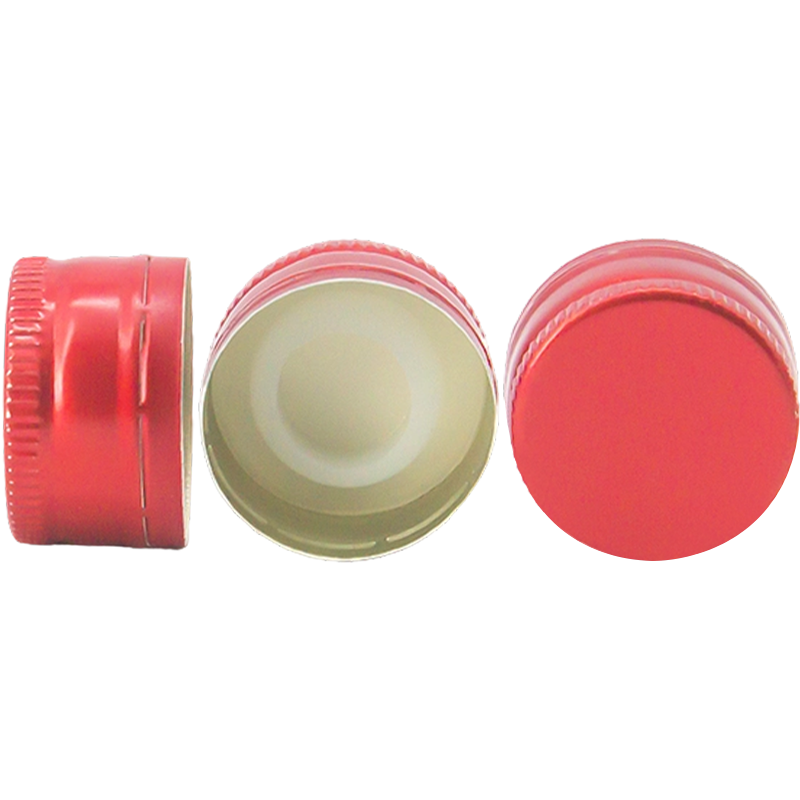 Aluminum Screw Caps for Oral Liquid BottlesA single-piece aluminum closure for oral liquid bottles that forms a resealable thread and uses a pre-scored skirt to show tamper evidence.View Product →
How Screw Caps Compare with Other Aluminium Closures
Screw caps solve a different problem from the closures used on injection vials and infusion bottles. Those are crimped on, opened once and destroyed in the process. A screw cap is opened and closed repeatedly across the shelf life of a multi dose liquid, so thread engagement and liner recovery matter more than crimp force.
| Closure type | How it opens | Typical container | Best fit |
|---|---|---|---|
| Screw cap | Unscrews, can be closed again | Oral liquid and syrup bottles | Multi dose liquids opened many times |
| Pull ring cap | Ring is pulled, top section tears away | Injection vials, infusion bottles | High speed lines needing no tool to open |
| Tear off cap | Top disc is removed and discarded | Injection vials, oral liquids | Single use with clear tamper evidence |
| Bridge type cap | Hinged bridge flips up and reseals | Infusion bottles, injection vials | Repeated needle access |
| Middle hole cap | Central hole exposes a rubber stopper | Injection vials | Piercing with a needle or spike |
Two practical consequences follow. A screw cap cannot replace a crimp cap on an injection vial, because the neck finish and the sealing principle are both different. And when a product is opened many times, the liner must recover its thickness after each compression, which rules out low cost foam with poor compression set.
The wider family of closures, including pull ring and tear off designs, is described in this guide to aluminium caps for pharmaceutical vials.
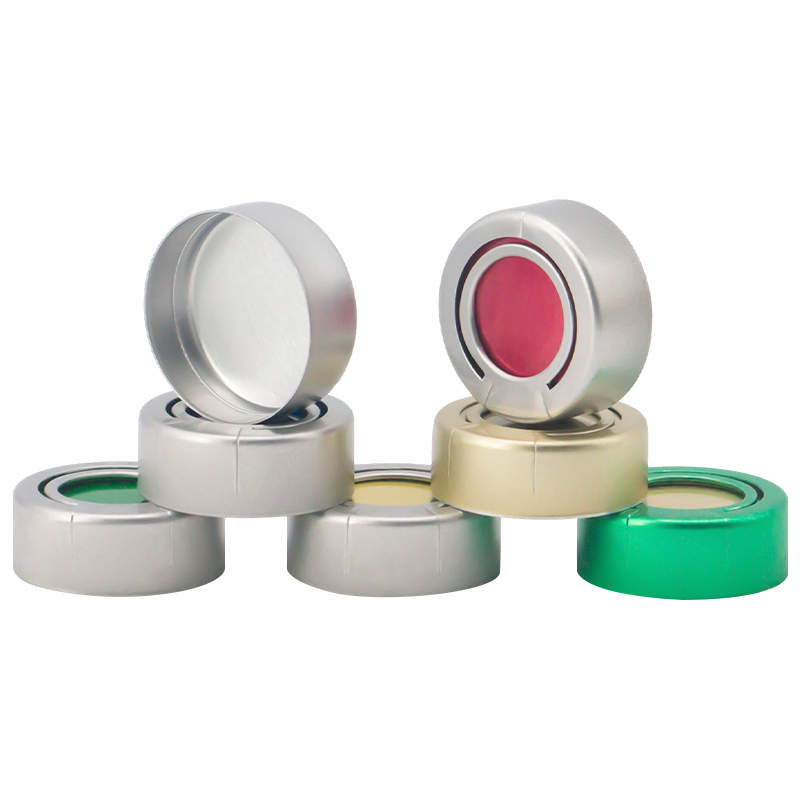 Aluminum Pull-Ring Caps for Injection VialsA tamper-evident aluminum seal with an integrated pull-ring that removes cleanly to expose the rubber stopper for safe needle access.View Product →
Neck Finish and Thread Tolerance Decide the Fit
Neck finish is where most screw cap aluminium problems begin. A glass bottle neck is not a simple cylinder. It has a thread with a start point, a root diameter, a land at the top and a defined height. Standards such as DIN 168 and the GCMI range describe these dimensions, but two bottles that both pass a 20 mm gauge can still differ enough to change capping behaviour.
What to measure on the glass
- Thread outer diameter and root diameter, checked with go and no go gauges.
- Land width and flatness, because the liner seals against the land rather than the thread.
- Thread start position, which decides whether the cap sits square or cocks to one side.
- Neck height, which sets how much skirt is engaged when the cap is fully applied.
On the cap side, skirt inner diameter typically holds a tolerance of plus or minus 0.1 mm, and the thread profile is tooled to one glass finish rather than to a nominal size. If a filler buys bottles from two moulds or two suppliers, the cap drawing should be checked against both. A 0.3 mm difference in thread diameter is enough to shift the torque needed to close the same cap by several in-lb.
Liner Choice Protects More Than the Shell Does
Liner selection decides what the cap actually protects against. Four liner families cover most pharmaceutical screw cap work.
- Induction foil seal: aluminium foil laminated to a polymer film and heat sealed to the bottle land. It gives a hermetic seal, clear tamper evidence, and is peeled or pierced by the user. Best for hygroscopic and oxygen sensitive products.
- PE foam or EPE liner: a compressible disc that reseals after the foil is removed, often combined with an induction foil in a two piece liner.
- Pulp or paperboard backed liner: low cost, suited to dry and non aggressive contents, weak moisture barrier.
- Silicone or PTFE faced liner: chosen for chemical resistance when the fill attacks polyethylene.
Two specifications matter more than the rest. The first is compression set, the tendency of the liner to stay flattened after repeated closing. A liner with high compression set leaks after the twentieth opening even though it passed the first leak test. The second is compatibility with the fill, because essential oils, alcohol based drops and acidic syrups all behave differently against polyethylene.
Torque, Line Setup and the Numbers Behind Leakage
Application torque ties the cap, liner and bottle together. Too little and the cap backs off in transit. Too much and the skirt distorts, the thread jumps, and older patients cannot open the bottle.
As a starting point, a 20 mm screw cap on a glass oral liquid bottle is applied between 8 and 14 in-lb, and a 28 mm cap between 12 and 20 in-lb. Those ranges are starting points, not standards. The correct figure is the one that produces a removal torque above the minimum your stability programme requires, measured 24 hours after capping so the liner has relaxed.
Line settings that change the result
- Chuck condition: worn or polished chucks slip, so the head reaches its set torque without turning the cap.
- Magnetic clutch setting: verify it against a torque tester at the start of each shift rather than once at commissioning.
- Bottle height variation: a bottle 1 mm shorter than the setting gets less thread engagement and the cap sits low.
- Line speed: at high speed a cap can cross thread before the clutch engages, which is a bottle problem as often as a cap problem.
Quality Checks and Documentation Buyers Should Request
Each lot should arrive with a defined set of evidence, not only a delivery note.
- Dimensional report covering skirt diameter, height, thread profile and liner thickness.
- Liner material certificate with grade declaration and migration data where relevant.
- Torque results for application and removal, with the test method stated.
- Leak testing by vacuum decay or dye penetration on a defined sample size.
- Cleanroom class and environmental control records for the production area.
- Certificate of analysis tying the lot number to the tested samples.
The manufacturing environment is part of that evidence. Suppliers working to GMP and ISO 9001 with a controlled cleanroom are set up to hold particulate and bioburden limits that a general metal stamping shop cannot. Jiangsu Changjiang Lids, for example, states that it runs a C plus A grade cleanroom and reports annual capacity of 3 billion aluminium and aluminium plastic caps plus 800 million polypropylene caps. Figures of that kind are useful when a filler needs to confirm a supplier can carry a multi year programme, but they should still be verified against the supplier records during qualification.
Specifying a Screw Cap Aluminium Order
A specification that survives qualification usually contains the following items. Leaving any of them to standard is what makes the second order behave differently from the first.
- Neck finish standard and drawing number, plus the glass supplier mould reference.
- Cap diameter, height, thread profile and skirt tolerance.
- Liner type, thickness, and whether an induction seal is required.
- Target application torque and minimum removal torque.
- Surface finish: mill finish, lacquered or anodised, with a colour reference.
- Printing or embossing position and artwork tolerance.
- Packaging format, bag count per carton and inner liner requirement.
- Documentation set and sampling plan for incoming inspection.
- OEM tooling ownership where new artwork or a new thread is involved.
Tooling lead time is the item that most often delays a launch. A new thread profile or embossed logo needs a press tool, and that tool needs trial caps on real bottles before approval. Sending the glass to the cap maker for trial capping is faster than approving a drawing in isolation.
 Aluminum and Aluminum-Plastic Caps for Oral LiquidsAluminum and aluminum-plastic closures for syrups, suspensions and tinctures, offering tamper evidence, sealing integrity and compatibility with common neck sizes.View Product →
Screw cap aluminium is a small component carrying a large share of the risk in a liquid filling operation. The cap that seals reliably is not the thickest or the most expensive one. It is the one whose thread was tooled to a measured neck finish, whose liner was chosen for the fill and the number of openings, and whose torque was set on the line and checked every shift.
When qualifying a new bottle or a new cap, start with the glass drawing and the fill, then work outward to the shell and the liner. Samples capped on your own bottles, tested for torque and leakage, will tell you more than any catalogue.
You can request samples or review a specification through the contact page.
Related products
-
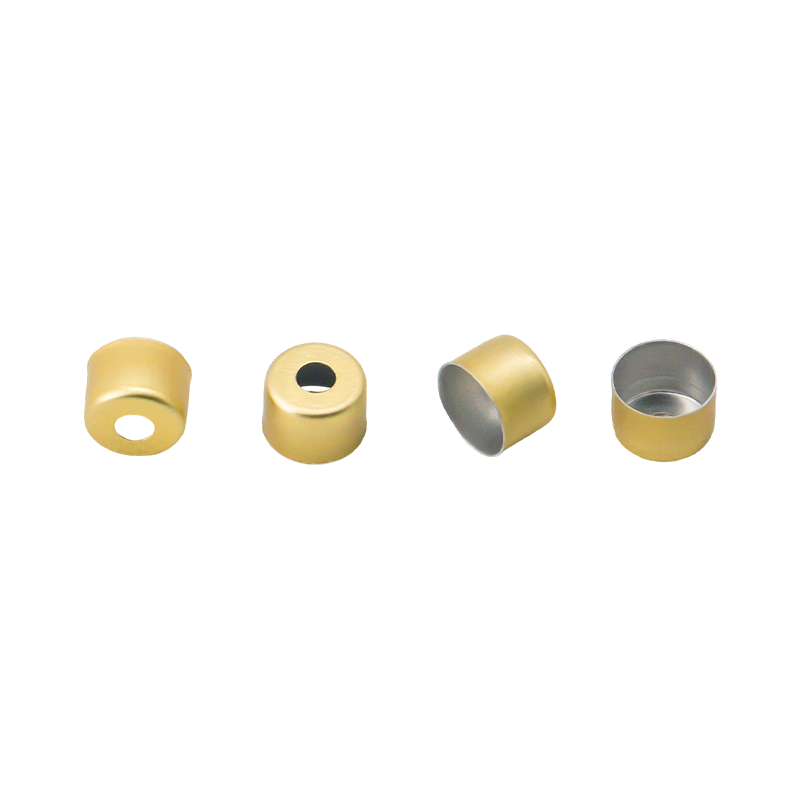
A precision sealing solution designed for cartridge-based drug delivery systems, such as pre-filled syringes and pen injectors. It ensures sterile integrity and safe, reliable needle access for inject...
View More -
A standardized dual-port polypropylene cap designed for infusion and solution bottles. This integrated solution ensures reliable closure and provides two distinct, self-sealing access points for safe ...
View More -
A protective and sterile packaging solution designed for contact lens storage. The polypropylene (PP) container with an integrated foil seal ensures product integrity, moisture retention, and contamin...
View More -
A protective and sterile packaging solution designed for contact lens storage. The polypropylene (PP) container with an integrated foil seal ensures product integrity, moisture retention, and contamin...
View More -

A secure and low-profile support solution designed to safely hold infusion containers in clinical and care settings. Its flat design ensures stable wall-mounted suspension and easy access for intraven...
View More -

A secure and ergonomic support solution designed to safely hold infusion containers in clinical and care settings. Its racket design with an integrated handle ensures stable, portable suspension and e...
View More
-
Get In Touch
 +86 511 8813 2922
 +86 139 5290 2286
 lilian@changjianglids.com
 No. 1 Mingzhu Road, Youfang Industrial Park, Yangzhong City, Zhenjiang, Jiangsu, China
The information provided on this website is intended for use only in countries and jurisdictions outside of the People's Republic of China.
-
Product
Aluminum-Plastic Caps Aluminum Caps Euro PP Caps PP Containers for Contact Lens with Foil Seal Plastic Hanger for Infusion Bottle Plastic Jerry Can -
WhatsApp
Chris

-
WeChat
Lilian

Copyright © 2025 Jiangsu Changjiang Lids Co., Ltd. All Rights Reserved.
OEM Pharmaceutical Packaging Manufacturer
Pharmaceutical Cap Supplier
