
 English
 русский
 简体中文
简体中文


Home / News / Industry News / PP Containers for Contact Lens Packaging: Why Foil Seal Design Matters for Lens Safety and Shelf Life
PP Containers for Contact Lens Packaging: Why Foil Seal Design Matters for Lens Safety and Shelf Life
2026.03.12
Content
- 1 The Global Contact Lens Market and the Packaging That Supports It
- 2 What Are PP Containers for Contact Lens and How Do They Work?
- 3 1-pc PP Containers for Contact Lens: Design, Applications, and Advantages
- 4 5-pcs PP Containers for Contact Lens: Multi-Unit Convenience for Professional and Retail Applications
- 5 Regulatory Standards and Compliance Requirements for PP Containers for Contact Lens
- 6 Quality Control Testing for PP Containers for Contact Lens
- 7 How to Select the Right PP Containers for Contact Lens Applications
- 8 Sustainability Considerations for PP Containers for Contact Lens
- 9 Frequently Asked Questions About PP Containers for Contact Lens
- 9.1 Q1: What is the difference between 1-pc and 5-pcs PP containers for contact lens?
- 9.2 Q2: Can PP containers for contact lens withstand autoclave sterilization?
- 9.3 Q3: What is the typical shelf life of a contact lens stored in PP containers for contact lens with foil seal?
- 9.4 Q4: What is the foil seal in PP containers for contact lens made of?
- 9.5 Q5: Are PP containers for contact lens recyclable?
- 9.6 Q6: What biocompatibility standards apply to PP containers for contact lens?
- 9.7 Q7: Can PP containers for contact lens be customized with printed information or branding?
- 9.8 Q8: What documentation should a supplier of PP containers for contact lens provide?
In pharmaceutical manufacturing, the closure system is one of the most consequential decisions a packaging engineer will make. PP containers for contact lens packaging must do far more than simply hold a lens — they must maintain sterility from the moment of manufacture through the point of patient use, preserve the saline or buffered solution in which the lens is stored, prevent moisture loss that would deform or damage the lens, and withstand the rigors of distribution, retail display, and home storage without compromising product integrity.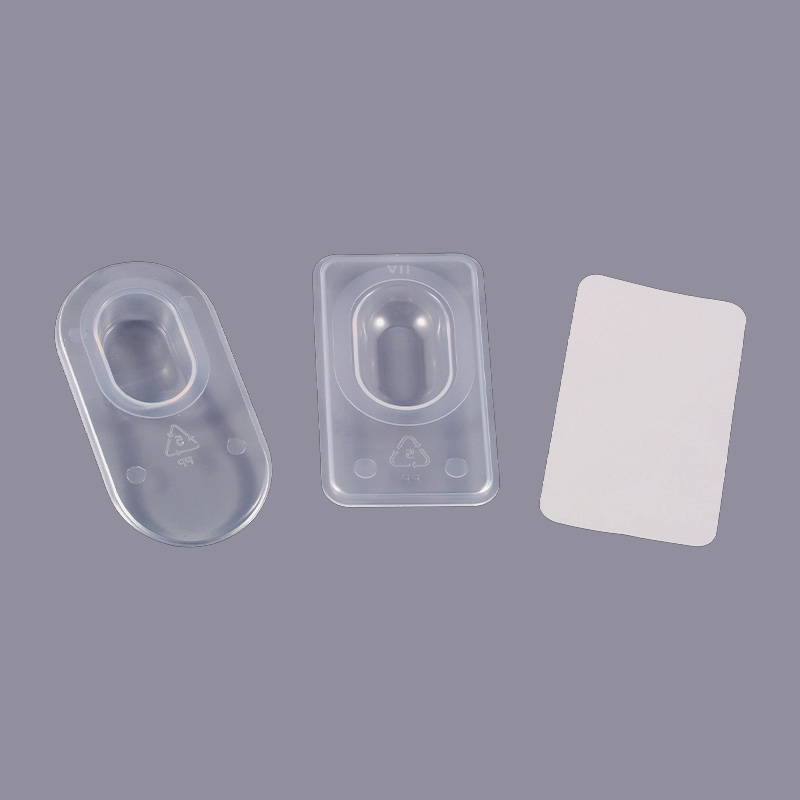
The polypropylene (PP) container with foil seal has become the industry-standard primary packaging format for soft contact lenses worldwide. Available in both single-unit (1-pc) and multi-unit (5-pcs) configurations, PP containers for contact lens products are used by the world's largest contact lens manufacturers to package daily disposable lenses, monthly replacement lenses, extended-wear lenses, and trial or sample lens products destined for fitting rooms and promotional use.
This article examines the design principles, material science, regulatory requirements, and practical selection criteria for PP containers for contact lens applications — covering both the 1-pc and 5-pcs configurations and explaining why the differences between them matter for manufacturers, brand owners, and procurement professionals.
The Global Contact Lens Market and the Packaging That Supports It
The global contact lens market was valued at approximately $12.5 billion in 2023 and is projected to grow at a compound annual growth rate (CAGR) of around 5.8% through 2030, driven by rising rates of myopia worldwide, growing consumer preference for daily disposable lenses, and expanding market penetration in Asia-Pacific and Latin America.
Daily disposable lenses alone account for over 40% of total contact lens unit volume in mature markets such as the United States, United Kingdom, and Japan — and each pair of daily lenses requires two individual containers. With an estimated 140 million contact lens wearers globally, the annual volume of PP containers for contact lens production runs into the tens of billions of units. This scale demands packaging that is not only functionally reliable but also manufacturable with extreme consistency at high speed and low cost per unit.
The PP containers for contact lens with foil seal have proven to be the most effective and commercially scalable solution to meet these demands. Their dominance across all major lens categories — from mass-market daily disposables to premium extended-wear silicone hydrogel lenses — reflects decades of refinement in material selection, container geometry, seal technology, and manufacturing process control.
What Are PP Containers for Contact Lens and How Do They Work?
PP containers for contact lens are small, shallow blister packs formed from polypropylene resin, designed to hold a single soft contact lens submerged in a specified volume of sterile saline or buffered preservative-free solution. Each container consists of two primary components: the formed PP bowl (also called the cup or blister) and the foil lid (also called the foil seal or lidding).
The PP bowl is thermoformed or injection-molded to a precise geometry that accommodates the lens without allowing it to fold, crease, or adhere to the container walls. The bowl holds a controlled volume of solution — typically between 0.5 mL and 1.0 mL — sufficient to keep the lens fully hydrated throughout its shelf life, which may extend to one to three years from the date of manufacture depending on the product and formulation.
The foil seal is heat-sealed or pressure-sealed to the flat flange around the perimeter of the PP bowl, creating a hermetic closure that prevents evaporation of the storage solution and excludes microbial contaminants. The foil is designed to peel away cleanly when the user opens the container — providing a smooth, controlled peel experience without tearing, delaminating, or leaving adhesive residue on the lens or the container bowl.
Why Polypropylene Is the Material of Choice for Contact Lens Containers
Polypropylene was selected as the standard material for PP containers for contact lens applications because of its unique combination of properties:
- Chemical inertness: PP does not react with the saline or buffered solutions used to store contact lenses, and does not leach plasticizers, stabilizers, or other additives that could damage the lens polymer or irritate the ocular surface.
- Low moisture vapor transmission rate (MVTR): PP is one of the most moisture-resistant commodity plastics, a critical property for preserving the water content of the storage solution over a multi-year shelf life.
- Sterilization compatibility: PP withstands steam autoclave sterilization and gamma irradiation without significant dimensional change or chemical degradation, both of which are used to sterilize filled contact lens containers.
- Optical clarity: Medical-grade PP can be produced with sufficient translucency to allow visual inspection of the lens and solution inside the container without opening it.
- Formability and dimensional consistency: PP can be thermoformed or injection-molded to tight dimensional tolerances, supporting high-speed, high-precision manufacturing at the scale required by major lens manufacturers.
- Cost efficiency: PP is one of the most widely produced and cost-effective medical-grade polymers globally, supporting the economics of high-volume daily disposable lens production.
The Role of the Foil Seal in PP Containers for Contact Lens
The foil seal is the component that transforms the PP bowl from an open container into a hermetically sealed, sterile primary package. In PP containers for contact lens applications, the foil is typically a laminate structure consisting of an aluminum foil layer bonded to one or more polymer layers — commonly polyethylene (PE) or polyethylene terephthalate (PET) — that provide the heat-seal interface with the PP flange and the outer print or coating surface.
The aluminum foil layer provides the primary barrier function — blocking moisture vapor transmission, oxygen ingress, and light exposure that could degrade the storage solution or promote microbial growth. Foil seal integrity is one of the most critical quality attributes of the finished container. A seal that is too weak risks delaminating during distribution or storage; a seal that is too strong makes the container difficult to open without spilling the contents or flicking the lens. Seal strength is validated as part of the container qualification process and monitored during production using peel force testing at defined intervals.
1-pc PP Containers for Contact Lens: Design, Applications, and Advantages
The 1-pc PP containers for contact lens packaging is a single-unit blister pack designed to hold one contact lens — either the left eye or right eye lens — in a defined volume of sterile storage solution. It is the fundamental unit of contact lens primary packaging and forms the basis of all daily disposable lens products and most single-lens presentations globally.
Physical Design and Geometry
The 1-pc container is designed with a shallow, curved bowl geometry that mirrors the approximate shape of the contact lens at rest in solution. The bowl diameter is sized to accommodate the full range of standard soft contact lens diameters — typically 13.8 mm to 14.5 mm — with sufficient clearance to prevent the lens from contacting the bowl walls during handling and shipping.
The flat flange surrounding the bowl provides the sealing surface for the foil lid and typically carries printed information — including lens parameters (base curve, diameter, power), lot number, expiration date, and brand name — either directly on the foil or on an outer label applied to the foil surface.
A recessed tab or notch at one edge of the flange provides a grip point for initiating the foil peel — an important ergonomic feature given that contact lens users must open the container with clean, dry fingers without contaminating the lens or solution inside.
Key Applications of 1-pc PP Containers for Contact Lens
- Daily disposable contact lenses: The largest single application. Daily disposables are worn once and discarded, so each wearing requires opening two fresh containers. Box presentations of 30 or 90 lenses (15 or 45 1-pc containers per eye) are standard at retail.
- Monthly replacement lenses: Packaged as individual 1-pc containers for each lens, with the user replacing both lenses on a monthly schedule.
- Preservative-free saline lens storage: Some lens products are packaged in preservative-free buffered saline specifically formulated for sensitive eyes. The hermetic foil seal of 1-pc PP containers for contact lens is essential for maintaining the preservative-free condition throughout shelf life.
- Trial and fitting lenses: Eye care practitioners use single 1-pc containers to provide trial lenses for fitting appointments, allowing patients to evaluate lens comfort and vision correction before committing to a purchase.
- Specialty lenses: Toric lenses for astigmatism correction, multifocal lenses, and cosmetic/colored lenses are all commonly packaged in 1-pc containers.
Advantages of the 1-pc Format
The 1-pc format of PP containers for contact lens offers several important advantages from both a product integrity and user experience perspective. Each lens is sealed in its own individual sterile environment, meaning that opening one container does not expose any other lens to contamination or solution evaporation. This is particularly important for daily disposable products where any compromise of the sterile barrier would require discarding the affected lens.
From a logistics perspective, individual containers can be combined into multi-pack cartons — typically 5, 10, 30, or 90 units per box — with flexible configurations to meet different retail, professional, and promotional channel requirements. The unit-level format also supports individual serialization and traceability for regulatory and anti-counterfeiting purposes.
5-pcs PP Containers for Contact Lens: Multi-Unit Convenience for Professional and Retail Applications
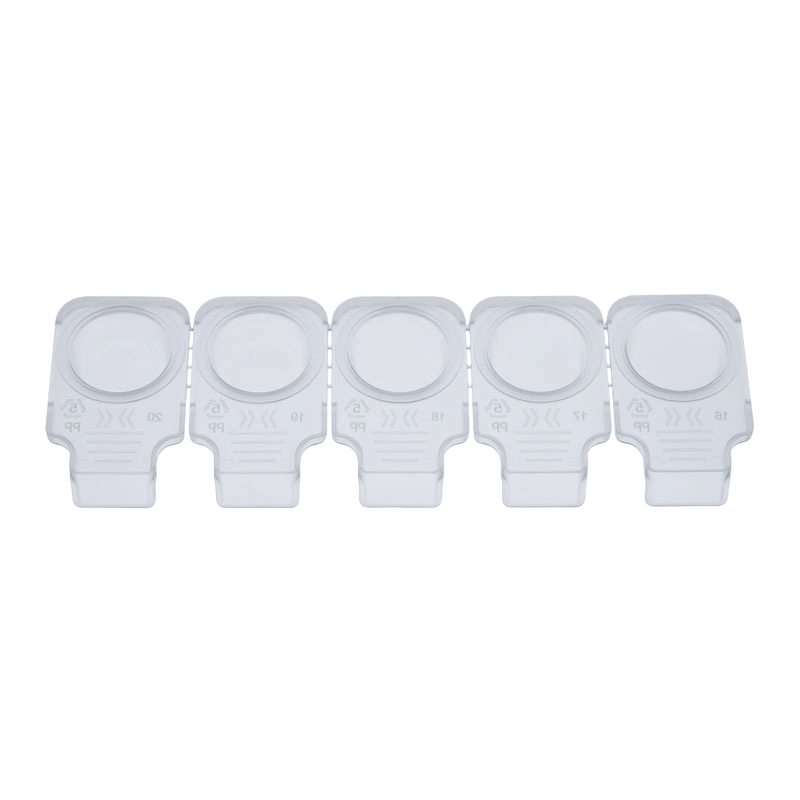
The 5-pcs PP containers for contact lens configuration integrates five individual contact lens blister units into a single connected strip or card format, with each blister maintaining its own independent hermetic foil seal. This format provides the same per-unit sterility and product protection as the 1-pc container while offering important practical advantages in packaging efficiency, consumer convenience, and retail presentation.
Physical Configuration and Design Features
In the 5-pcs configuration of PP containers for contact lens, five PP blister bowls are formed in a linear strip from a single piece of PP sheet, connected by a flat web between each unit. Each individual bowl retains the same geometry, volume, and dimensional specifications as a standalone 1-pc container. The foil seal is typically applied as a single sheet over the entire strip, heat-sealed across all five flanges simultaneously, but perforated between units to allow individual blisters to be torn off when needed.
The perforation design is a critical functional element. The tear line must be positioned and engineered so that separating one unit from the strip does not compromise the foil seal of adjacent units. This requires precise control of the perforation depth, spacing, and alignment relative to the seal zone of each blister.
The 5-pcs strip format is more compact per unit than five separate 1-pc containers because the connecting web between blisters eliminates the individual flange area that would otherwise surround each standalone container. This compactness translates directly into reduced secondary packaging material requirements and lower per-unit shipping costs — a meaningful advantage at the volumes involved in contact lens manufacturing.
Key Applications of 5-pcs PP Containers for Contact Lens
- Daily disposable lens retail packaging: The most common commercial presentation for daily disposable lenses in many markets is a box of 30 lenses per eye, containing six 5-pcs strips. This format is convenient for consumers to store and use, and allows easy day-by-day tracking of lens usage.
- Monthly and two-weekly replacement lenses: Some manufacturers use 5-pcs strips for economy pack sizes (boxes of 5 or 10 lenses) to improve packaging efficiency.
- Sample and trial lens kits: The 5-pcs strip format is widely used for professional sample packs provided to eye care practitioners for patient fitting. A strip of five trial lenses in a range of parameters provides practitioners with a compact, organized trial lens kit.
- Promotional multi-packs: Manufacturers use 5-pcs strips as the basis for promotional pack configurations, offering extended supply (e.g., 90-day packs) as a consumer loyalty driver.
Advantages of the 5-pcs Format
The 5-pcs format of PP containers for contact lens offers a measurable set of practical advantages over equivalent quantities of individual 1-pc containers:
- Handling efficiency: On filling and packaging lines, handling five connected units simultaneously reduces the number of individual container movements required, supporting higher line efficiency and lower per-unit processing cost.
- Consumer convenience: Users can easily count and track daily lens usage when lenses are packaged in five-unit strips, reducing the risk of miscounting in a box of 30 or 90 lenses.
- Reduced packaging material waste: The shared web between units reduces total PP material use per lens compared to five standalone 1-pc containers, contributing to packaging sustainability metrics.
- Compact secondary packaging: A box of 30 daily lenses containing six 5-pcs strips occupies less volume than the equivalent 30 individual 1-pc containers, reducing retail shelf space requirements and shipping cube.
Regulatory Standards and Compliance Requirements for PP Containers for Contact Lens
Contact lenses are regulated as medical devices in all major markets, and PP containers for contact lens products are subject to correspondingly rigorous regulatory requirements. The container must comply with applicable standards for materials, sterility, packaging performance, and labeling.
ISO Standards Applicable to PP Containers for Contact Lens
The primary international standard framework for PP containers for contact lens packaging is ISO 11607 (packaging for terminally sterilized medical devices), which establishes requirements for sterile barrier systems and protective packaging. ISO 11607 applies directly to the foil-sealed PP container as a sterile barrier system, requiring validation of seal integrity, packaging material biocompatibility, and sterile barrier performance throughout the product shelf life.
ISO 18369 (ophthalmic optics — contact lenses) provides the product-level standard framework for soft contact lenses, including requirements relevant to packaging in terms of solution composition and lens parameter labeling.
Material Biocompatibility Requirements
All materials used in PP containers for contact lens that come into contact with the lens or the storage solution must comply with ISO 10993 (biological evaluation of medical devices), which requires assessment of cytotoxicity, sensitization, irritation, and systemic toxicity potential. The critical concern is extractables and leachables — compounds that migrate from the PP resin or foil adhesive into the storage solution and could subsequently transfer to the lens and the ocular surface.
PP resin used for contact lens containers must be medical-grade, free from restricted additives, and produced under controlled conditions with documented traceability. Common extractables of concern include residual monomers, antioxidant stabilizers, and processing aids. Suppliers must provide extractables data for their specific resin grades as part of the material qualification package.
U.S. FDA Requirements
In the United States, contact lenses and their packaging — including PP containers for contact lens storage — are regulated by the FDA as Class II or Class III medical devices under 21 CFR Part 886. The packaging system is evaluated as part of the Premarket Notification (510(k)) or Premarket Approval (PMA) submission. The packaging section must include container closure integrity data, extractables testing results, shelf life stability data, and sterilization validation documentation.
European MDR Requirements
Under the EU Medical Device Regulation (MDR 2017/745), PP containers for contact lens must comply with the General Safety and Performance Requirements (GSPRs) related to packaging and labeling (Annex I, Chapter III). Technical documentation submitted to the Notified Body for CE marking must include a complete packaging evaluation demonstrating compliance with ISO 11607 and relevant biocompatibility standards.
Sterilization Validation for PP Containers for Contact Lens
PP containers for contact lens are typically sterilized after filling by steam autoclave (moist heat sterilization) at 121°C for 15 to 30 minutes. The sterilization cycle must be validated to demonstrate a Sterility Assurance Level (SAL) of 10⁻⁶ or better. Validation includes physical integrity testing before and after sterilization, dimensional inspection, and accelerated aging studies to demonstrate that seal performance is maintained throughout the claimed shelf life.
Quality Control Testing for PP Containers for Contact Lens
Robust quality control at both the container supplier and the lens manufacturer level is essential to ensure consistent product integrity across production batches. The following tests are routinely applied to PP containers for contact lens with foil seals:
| Test | Method | Purpose |
|---|---|---|
| Seal integrity / leak test | Dye ingress, vacuum decay, or microbial challenge | Confirms hermetic seal prevents contamination and solution loss |
| Peel force (seal strength) | Tensile testing machine, 180° peel angle | Validates seal is strong enough for distribution but peelable by user |
| Dimensional inspection | Calibrated gauges / vision inspection system | Confirms bowl geometry, flange dimensions, and foil position are within specification |
| MVTR (moisture vapor transmission) | Gravimetric or ASTM E96 | Confirms barrier performance of foil seal over shelf life |
| Extractables testing | GC-MS, LC-MS analysis of solution extracts | Identifies and quantifies compounds migrating from PP or foil into storage solution |
| Autoclave resistance | Steam sterilization at 121°C, post-cycle inspection | Confirms dimensional stability and seal integrity after sterilization |
| Accelerated aging / shelf life | ASTM F1980, real-time aging at controlled conditions | Validates claimed product shelf life of 1–3 years |
| Visual and cosmetic inspection | 100% automated vision inspection or AQL sampling | Detects surface defects, deformation, print quality, and seal appearance |
How to Select the Right PP Containers for Contact Lens Applications
Selecting the correct PP containers for contact lens products is a multidimensional decision that involves technical, regulatory, commercial, and supply chain considerations. The following framework helps manufacturers and brand owners structure the evaluation process.
Step 1 — Define the Lens Product Parameters
Begin with the lens itself. What is the lens diameter? What is the expected solution volume required to fully submerge the lens and maintain hydration across the claimed shelf life? Is the storage solution preservative-free — requiring an especially robust hermetic seal in your PP containers for contact lens to prevent microbial ingress without a chemical antimicrobial agent? Is the lens a daily disposable, monthly, or extended-wear product?
Step 2 — Choose Between 1-pc and 5-pcs Format
The choice between 1-pc and 5-pcs configurations of PP containers for contact lens should be driven by the intended commercial presentation, filling line equipment, and secondary packaging design. If the product will be sold in boxes of 30 daily lenses, a 5-pcs strip configuration may offer significant handling and packaging efficiency advantages. If the product is a monthly replacement lens sold in boxes of three, individual 1-pc containers may be more appropriate.
Step 3 — Evaluate Supplier Capabilities
A qualified supplier of PP containers for contact lens should demonstrate: ISO 13485 (medical device quality management system) certification, experience supplying major contact lens manufacturers, comprehensive extractables and leachables data for their PP resin and foil laminate, validated autoclave compatibility data, and the capacity to supply at the volumes required with documented lot traceability.
Step 4 — Conduct a Formal Packaging Qualification
Before committing to a specific design of PP containers for contact lens for commercial production, a formal packaging qualification study should be conducted in accordance with ISO 11607. This includes installation qualification (IQ), operational qualification (OQ), and performance qualification (PQ) of the sealing process, as well as accelerated and real-time shelf life studies demonstrating that the sealed container maintains sterile barrier integrity and acceptable solution chemistry throughout the claimed product shelf life.
Sustainability Considerations for PP Containers for Contact Lens
The environmental footprint of PP containers for contact lens packaging has attracted growing attention from consumers, regulators, and brand owners. Daily disposable lenses — the fastest-growing product category — generate substantial packaging waste: a daily wearer discards approximately 730 individual blister packs per year, in addition to secondary cartons and product inserts.
PP is technically recyclable, but the small size of individual contact lens blisters makes them difficult to process in conventional curbside recycling streams. Several major contact lens manufacturers have established take-back recycling programs — most notably through TerraCycle — that collect used blister packs, foil lids, and lens packaging for specialist recycling.
Container manufacturers are responding to sustainability pressure through several approaches: reducing wall thickness while maintaining structural performance (light-weighting), exploring bio-based PP resins derived from renewable feedstocks, developing foil laminate structures with higher recycled content, and designing PP containers for contact lens that facilitate easier separation of the PP and foil components at end of life. For brand owners, communicating a credible sustainability story increasingly requires engagement with the full value chain — from resin sourcing through manufacturing, filling, distribution, and end-of-life recycling.
Frequently Asked Questions About PP Containers for Contact Lens
Q1: What is the difference between 1-pc and 5-pcs PP containers for contact lens?
A 1-pc container is a single individual blister unit holding one contact lens. A 5-pcs container is a connected strip of five individual blister units formed from a single piece of PP sheet, with each unit maintaining its own independent foil seal. Both formats of PP containers for contact lens provide equivalent per-lens sterility and product protection. The 5-pcs format offers advantages in handling efficiency, consumer convenience, and secondary packaging compactness for high-volume applications such as daily disposable lens retail packs.
Q2: Can PP containers for contact lens withstand autoclave sterilization?
Yes. Medical-grade PP has a melting point well above the sterilization temperature of 121°C used in standard pharmaceutical autoclave cycles. PP containers for contact lens are routinely sterilized by steam autoclave after filling and sealing. The sterilization cycle must be validated to confirm that the container maintains dimensional stability, seal integrity, and solution chemistry specifications after exposure to the specified temperature and time parameters.
Q3: What is the typical shelf life of a contact lens stored in PP containers for contact lens with foil seal?
Most contact lens products packaged in PP containers for contact lens have a labeled shelf life of one to four years from the date of manufacture, depending on the lens type, storage solution formulation, and container barrier performance. Shelf life is established through accelerated aging studies (per ASTM F1980) followed by confirmation with real-time stability data.
Q4: What is the foil seal in PP containers for contact lens made of?
The foil seal used in PP containers for contact lens is typically a multi-layer laminate consisting of an aluminum foil barrier layer bonded to a heat-seal polymer layer (usually PE or a PE-based copolymer) on the inner surface and a print or coating layer on the outer surface. The aluminum foil provides the primary moisture and oxygen barrier, while the heat-seal polymer layer bonds to the PP flange during sealing. The outer surface carries printed lens parameter information, lot number, expiry date, and brand graphics.
Q5: Are PP containers for contact lens recyclable?
The PP bowl component of PP containers for contact lens is made from recyclable plastic, and the aluminum foil component is also technically recyclable. However, because the container is a composite of different materials, it is not accepted by most conventional curbside recycling programs. Specialized recycling programs operated through initiatives such as TerraCycle accept used contact lens blister packs for specialist processing.
Q6: What biocompatibility standards apply to PP containers for contact lens?
PP used in PP containers for contact lens must comply with ISO 10993 for biological evaluation of medical devices. Relevant tests include cytotoxicity (ISO 10993-5), sensitization (ISO 10993-10), and an assessment of extractables and leachables from the material into the storage solution. The PP resin must be medical-grade, produced under GMP conditions, and supplied with documented traceability.
Q7: Can PP containers for contact lens be customized with printed information or branding?
Yes. The foil seal surface is the primary location for printed information on PP containers for contact lens. Printing can include lens parameters (base curve, diameter, power, color), lot number, expiration date, manufacturer details, and brand graphics. Custom foil printing is a standard service offered by contact lens container suppliers, subject to minimum order quantities that vary by supplier.
Q8: What documentation should a supplier of PP containers for contact lens provide?
A fully qualified supplier of PP containers for contact lens should provide: ISO 13485 quality management system certification, material specifications and certificates of conformance for PP resin and foil laminate, extractables and leachables test data, autoclave compatibility validation data, ISO 11607 packaging qualification data, dimensional specifications and tolerances, batch Certificate of Analysis for production lots, and regulatory filing documentation for applicable markets. Evidence of successful qualification by other contact lens manufacturers is also a strong indicator of supplier capability.
Related products
-
A protective and sterile packaging solution designed for contact lens storage. The polypropylene (PP) container with an integrated foil seal ensures product integrity, moisture retention, and contamin...
View More -

A protective and sterile packaging solution designed for contact lens storage. The polypropylene (PP) container with an integrated foil seal ensures product integrity, moisture retention, and contamin...
View More -

A secure and low-profile support solution designed to safely hold infusion containers in clinical and care settings. Its flat design ensures stable wall-mounted suspension and easy access for intraven...
View More -

A secure and ergonomic support solution designed to safely hold infusion containers in clinical and care settings. Its racket design with an integrated handle ensures stable, portable suspension and e...
View More -
A precision sealing solution designed for cartridge-based drug delivery systems, such as pre-filled syringes and pen injectors. It ensures sterile integrity and safe, reliable needle access for inject...
View More -
A standardized dual-port polypropylene cap designed for infusion and solution bottles. This integrated solution ensures reliable closure and provides two distinct, self-sealing access points for safe ...
View More
-
Get In Touch
 +86 511 8813 2922
 +86 139 5290 2286
 lilian@changjianglids.com
 No. 1 Mingzhu Road, Youfang Industrial Park, Yangzhong City, Zhenjiang, Jiangsu, China
The information provided on this website is intended for use only in countries and jurisdictions outside of the People's Republic of China.
No. 1 Mingzhu Road, Youfang Industrial Park, Yangzhong City, Zhenjiang, Jiangsu, China
The information provided on this website is intended for use only in countries and jurisdictions outside of the People's Republic of China. -
Product
Aluminum-Plastic Caps Aluminum Caps Euro PP Caps PP Containers for Contact Lens with Foil Seal Plastic Hanger for Infusion Bottle Plastic Jerry Can -
WhatsApp
Chris

-
WeChat
Lilian

Copyright © 2025 Jiangsu Changjiang Lids Co., Ltd. All Rights Reserved.
OEM Pharmaceutical Packaging Manufacturer
Pharmaceutical Cap Supplier
